What a handle is
A handle is a name you own on the web: username.md/yourname. It's a real web page
people can visit, and a real address programs can look up. It lists the accounts
you choose to share — GitHub, Bluesky, your website, your email — all in one
place, under one name. Change a link once and everyone who looks you up gets
the new answer.
# a handle is a page in a browser — and an address in a terminal
$ curl -s -H 'accept: application/json' https://username.md/v1/users/chris/profile
What "signed identity" means
Every answer your handle gives is cryptographically signed — sealed with a key
that only username.md controls, verifiable against public keys anyone can fetch.
When an app, a person, or an AI agent looks you up, they don't have to take the
page's word for it: the math proves the answer really came from your handle and
wasn't tampered with. A profile page says who you are. A signed profile
proves it.
# See the signature headers on any response
$ curl -sI -H 'accept: application/json' https://username.md/v1/users/chris/profile \
| grep -iE 'content-digest|signature'
# Content-Digest: sha-256=:<base64(sha256(body))>:
# Signature-Input: sig1=("content-digest" "@authority");created=...;keyid="platform-ed25519";alg="ed25519"
# Signature: sig1=:<base64(ed25519 signature)>:
What AI agents do with your handle
More and more of what visits the web isn't a person — it's software acting for
a person. Agents fetch username.md/you as JSON or Markdown, check the signature,
and get your links, your keys, and your rules for how you want to be contacted.
You publish once, on your terms. (Agents get their own instructions too — your
handle serves its own llms.txt.)
# Markdown for terminals and LLMs
$ curl -s -H 'accept: text/markdown' https://username.md/v1/users/chris/profile
# Instructions for AI agents interacting with this handle
$ curl -s https://username.md/users/chris/llms.txt
Verified claims
Anyone can type a GitHub URL into a bio. On username.md, you can
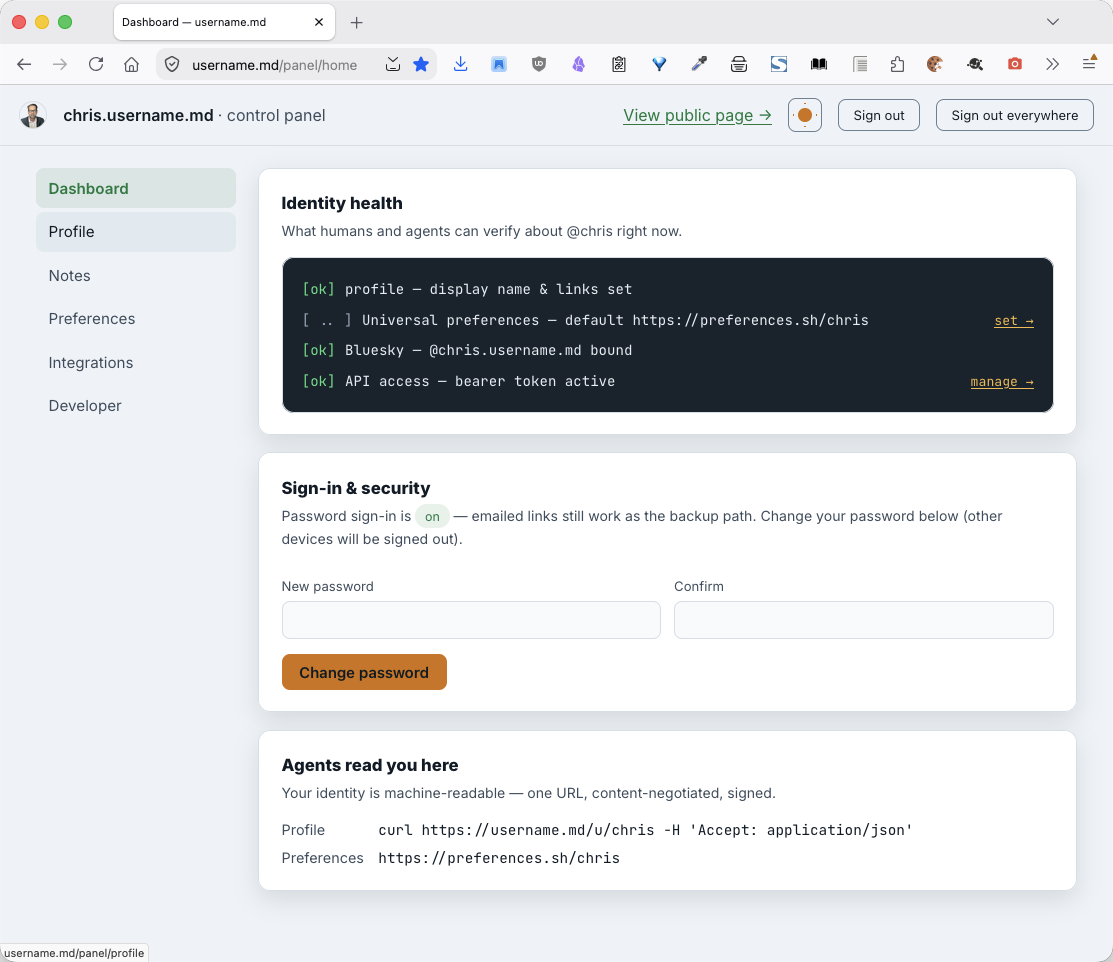
prove it. Verify a domain with a DNS record, bind your Bluesky account
so @you.username.md resolves across the network, or import your old Keybase
proofs — each check becomes a signed claim anyone can verify, even offline.
Your profile stops being a list of links and becomes a list of facts.
$ curl -s https://username.md/v1/users/chris/claims
# → { "did": "...", "public_jwk": {...}, "claims": [ { "type": "atprotoHandle", "jws": "...", ... } ] }
Portability
Your handle routes to you — not the other way around. Own a domain? Your
handle can resolve to did:web:yourname.com. Everything is open formats over
plain HTTPS. No walled garden, including ours.
# did:web document (public keys + service endpoints)
$ curl -s https://username.md/users/chris/.well-known/did.json